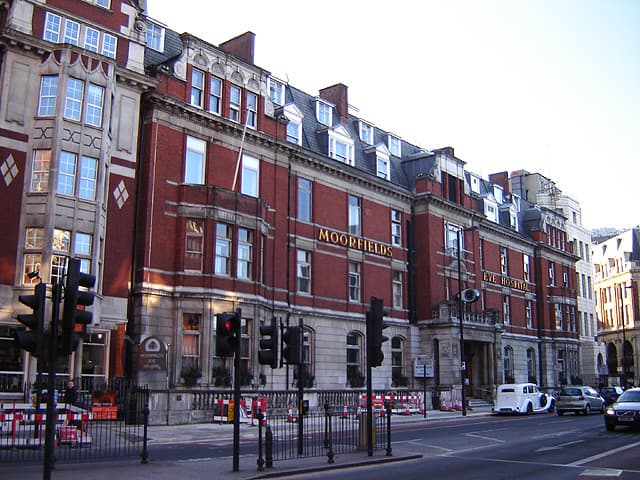
City Road · London
Moorfields Eye Hospital NHS Foundation Trust
Moorfields was founded in 1804 and, together with the adjacent UCL Institute of Ophthalmology, is the oldest and largest centre for ophthalmic treatment, teaching and research in Europe.
About this hospital
Moorfields Eye Hospital, together with the adjacent UCL Institute of Ophthalmology, is the oldest and largest centre for ophthalmic treatment, teaching, and research in Europe. It is part of Moorfields Eye Hospital NHS Foundation Trust, which operates the main City Road site in central London plus a network of satellite clinics across London and the South East. Annual outpatient volume TK. Every ophthalmology subspecialty is represented: medical retina, glaucoma, corneal, oculoplastics, paediatric ophthalmology, neuro-ophthalmology, genetic eye disease. Closely affiliated with the UCL Institute of Ophthalmology, which sits next door and is one of the leading eye research institutes internationally.
What it's like as a student here
Moorfields is unlike any other teaching hospital. The entire site is ophthalmology, which means the day revolves around clinic volume and theatre lists. Expect to see 40 to 60 patients pass through a consultant clinic in a morning. You'll learn to use the slit lamp early, and you'll get practised at direct ophthalmoscopy because there is simply nowhere else to look. Theatre lists run phacoemulsification (cataract) at pace: 8 to 12 cases in a half-day list is standard. Intravitreal injection lists are high-volume and efficient. The teaching culture is dense: consultants move quickly, but they will explain findings at the slit lamp if you ask. MDTs run for medical retina, uveitis, ocular oncology, and paediatric ophthalmology. A&E here is an ophthalmic emergency department and is busy: you'll see acute red eyes, trauma, retinal detachment presentations, and giant cell arteritis suspects within your first shift. Students typically rotate across two or three clinic subspecialties during a four-week placement.
Notable specialties
- Medical retina: high-volume intravitreal injection lists; diabetic eye disease and AMD.
- Glaucoma: major tertiary glaucoma service with SLT, trabeculectomy, and MIGS lists (UK-wide ranking TK).
- Corneal and external disease: penetrating keratoplasty, DMEK, DALK, severe ocular surface disease.
- Paediatric ophthalmology: squint surgery, amblyopia management, inherited retinal dystrophies.
- Oculoplastics: ptosis, lacrimal surgery, orbital tumour work.
- Neuro-ophthalmology: clinic shared with UCLH neurology.
- Genetic eye disease: inherited retinal disease MDT run jointly with the UCL Institute of Ophthalmology.
- Ophthalmic A&E: walk-in and referral eye emergencies.
Location & vibe
Old Street is a five-minute walk south on City Road. The area is a mix of tech offices (Silicon Roundabout), old-school pubs, and a busy traffic junction. Not residential, but Shoreditch, Clerkenwell, and Angel are all nearby and all have student-friendly rental stock. Commute from most of central and east London is easy on the Northern line.
Who does well here
Students seriously considering ophthalmology as a career, or any student who wants four weeks of intense subspecialty exposure. The learning curve is steep but the volume is unmatched.
One honest caveat
This is ophthalmology only; if you want broader medical exposure, this is the wrong placement.
Fully booked (current cycle)